

Power Electronics (power-electronics-ai999x)
Power Electronics covers DC-DC converters in continuous and discontinuous conduction (buck, boost, buck-boost, Cuk, SEPIC, flyback, forward, bridge), rectifiers and phase control, inverters and PWM, motor drives, device losses, snubbers, thermal and magnetic design and resonant converters: 79 calculations in 13 topics, each with its formula, its steps and its units, and a plain reason instead of a number when an input is missing or out of range. One compiled engine, four ways to use it: the desktop app, the command line, the browser and Python. Everything runs on your own computer, offline.
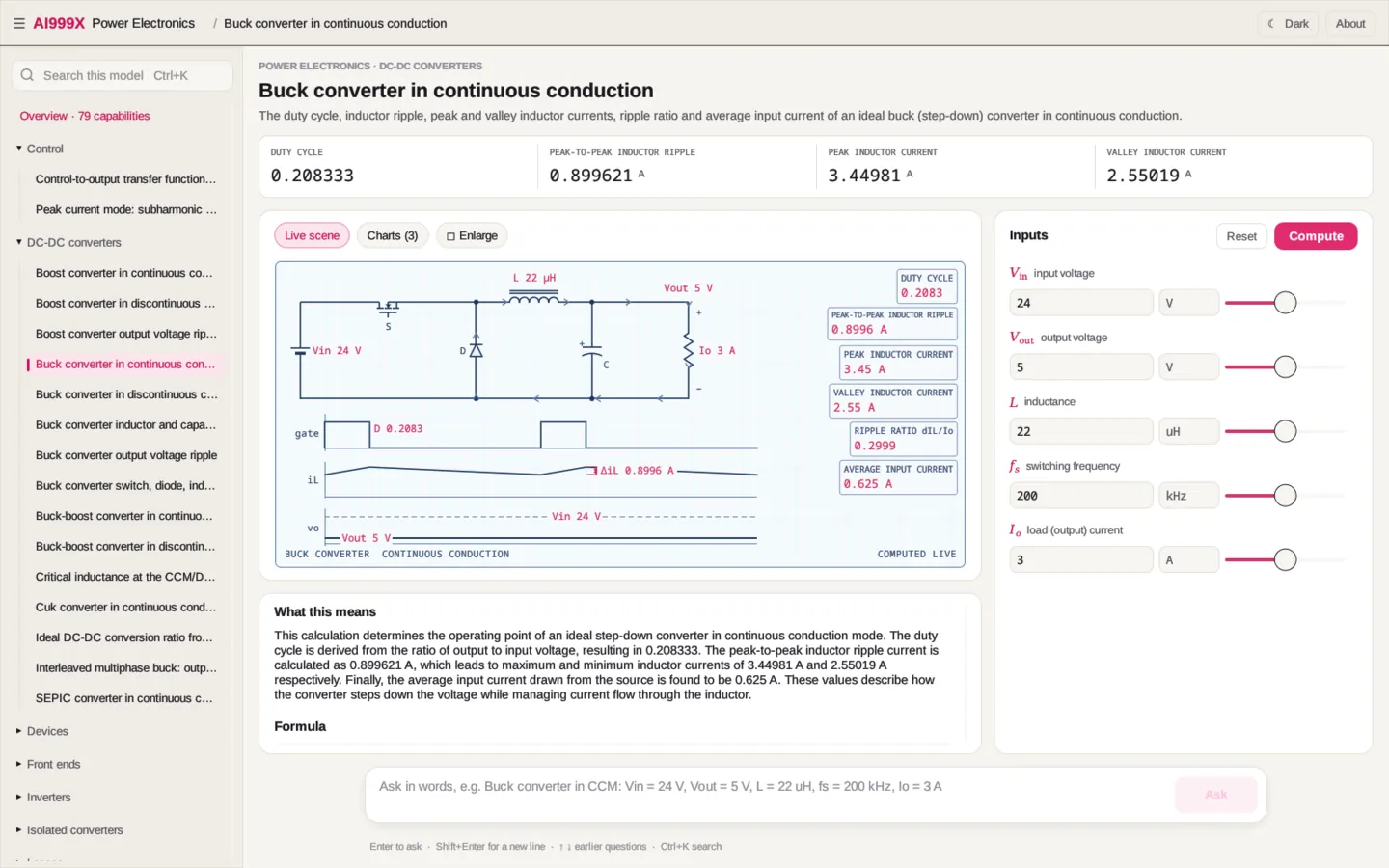
Four ways to use it
| Desktop app (Windows, Linux) | Windows · Linux |
Command line power-electronics (Windows, Linux) |
Windows · Linux |
| Browser (any device) | Try it on the model page |
| Python 3.10+ | pip install power-electronics-ai999x: on Windows and Linux (x86-64) pip installs the same compiled engine; on other systems (macOS, ARM) it installs a pure-Python build that gives the same answers |
See it
From the Power Electronics desktop app: every scene and chart is drawn from the computed answer.
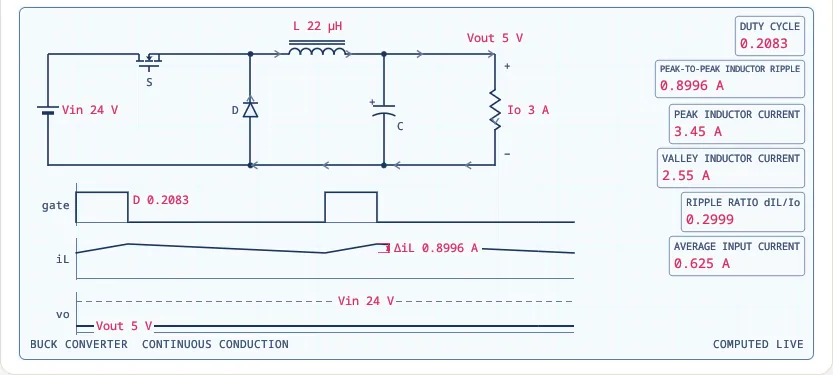 Buck converter in continuous conduction |
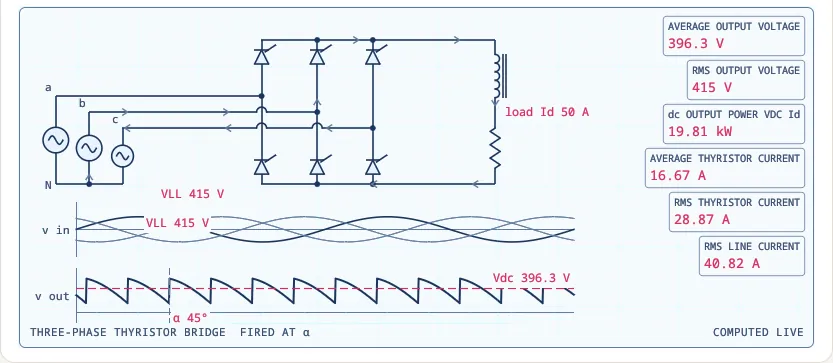 Three-phase fully controlled thyristor bridge |
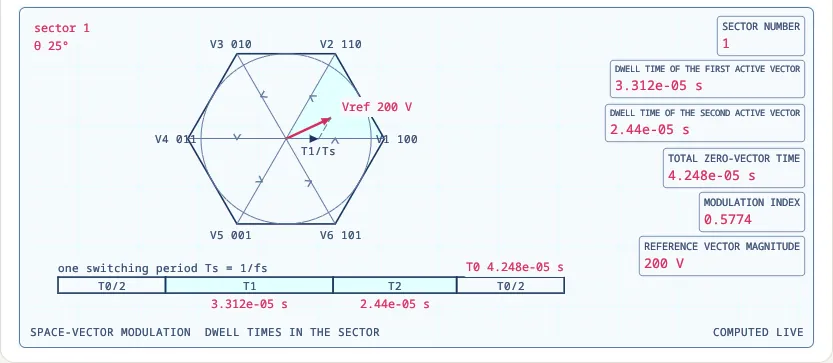 Space-vector modulation dwell times |
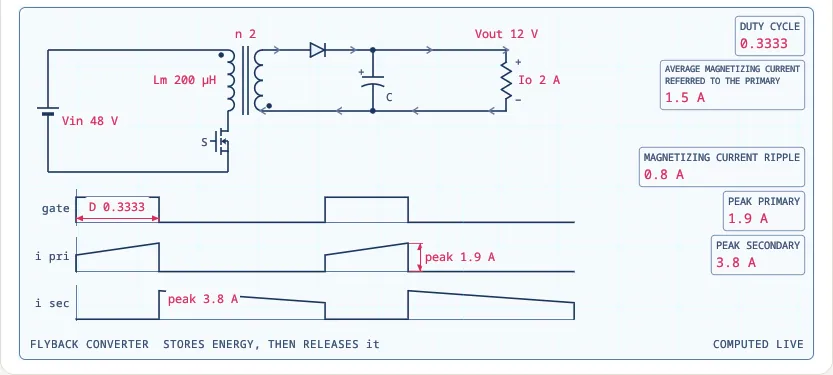 Flyback converter in continuous conduction |
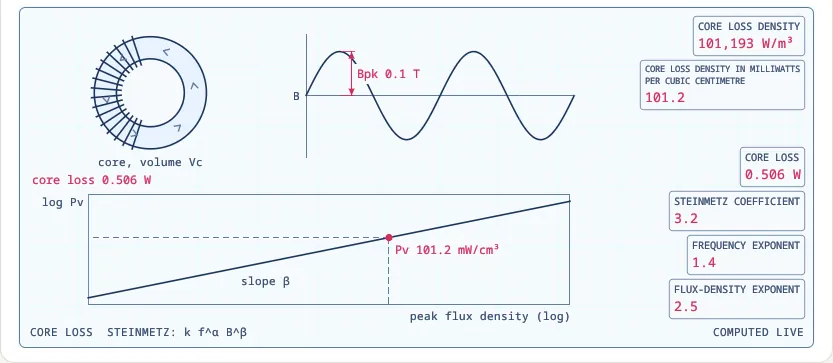 Core loss by the Steinmetz equation |
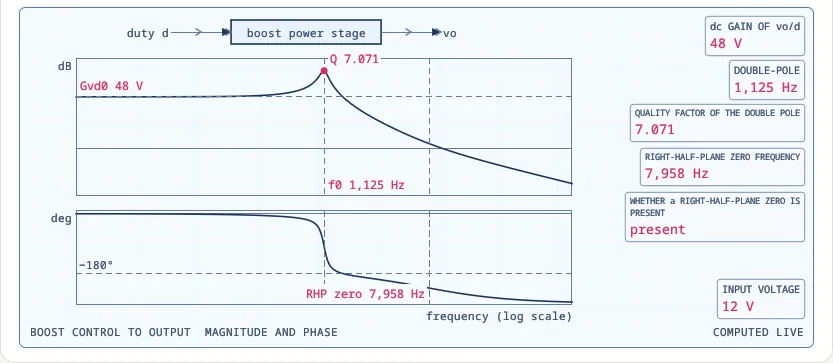 Control-to-output transfer function of a DC-DC converter |
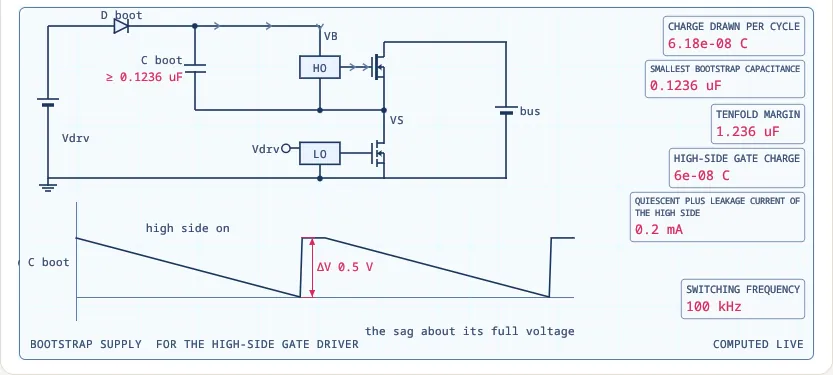 Bootstrap capacitor for a high-side gate driver |
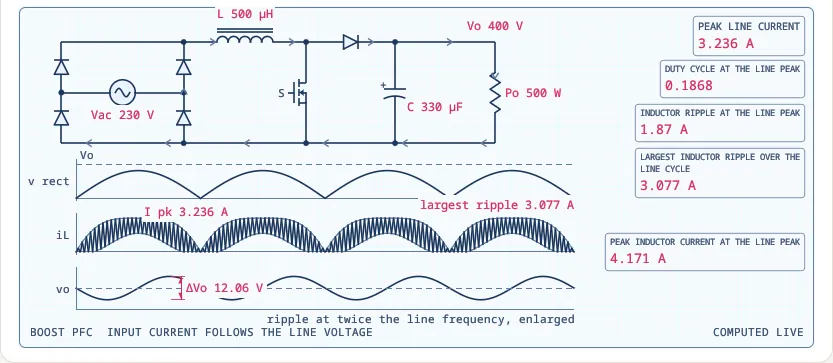 Boost power-factor-correction stage |
Charts:
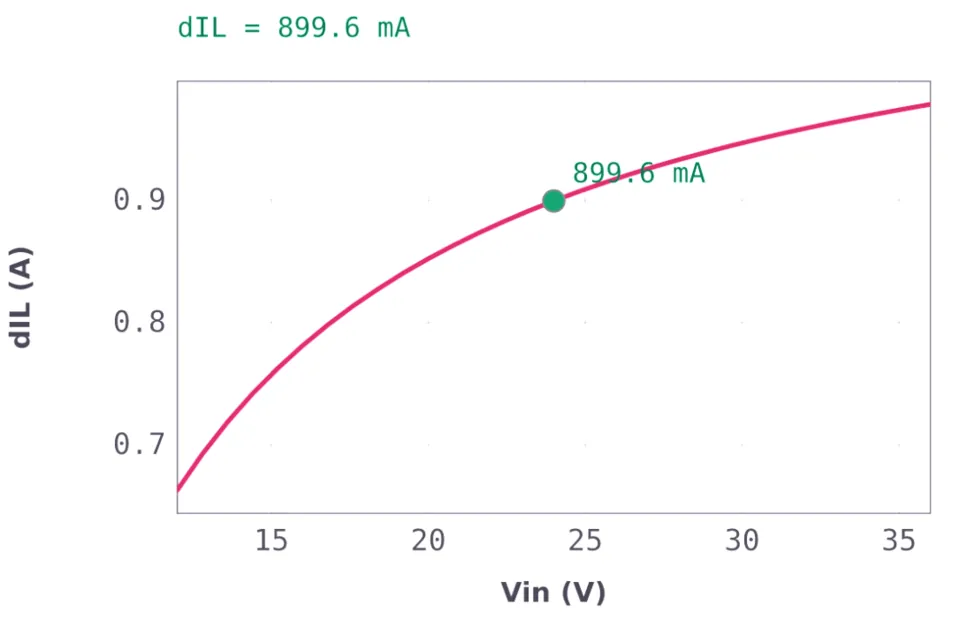 Buck converter in continuous conduction |
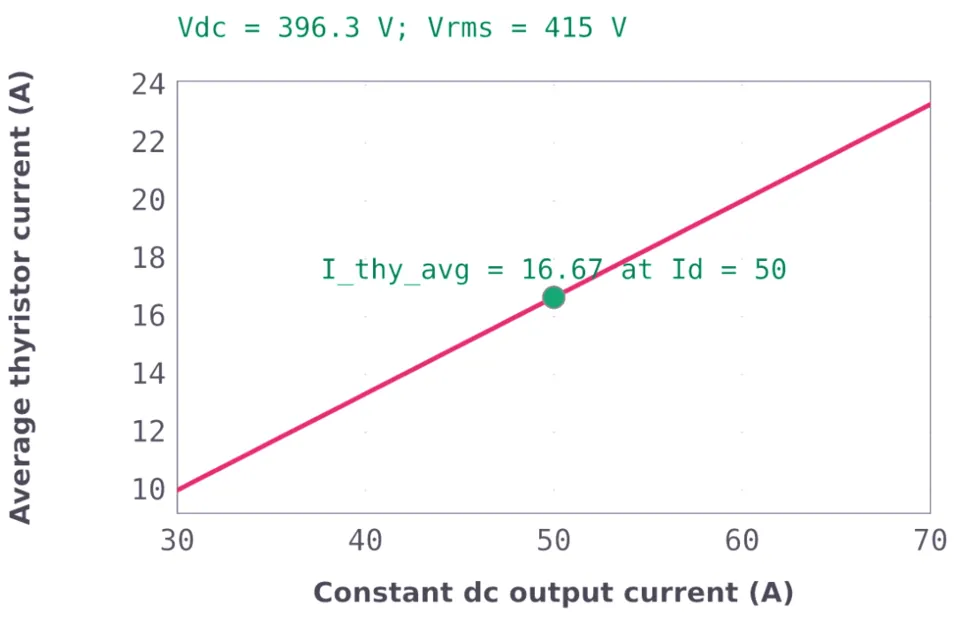 Three-phase fully controlled thyristor bridge |
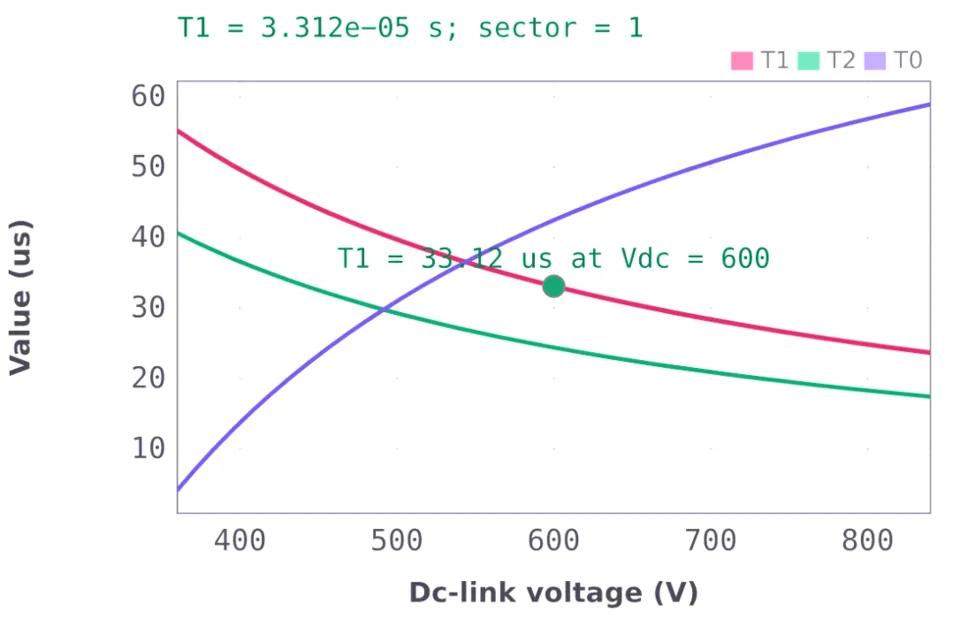 Space-vector modulation dwell times |
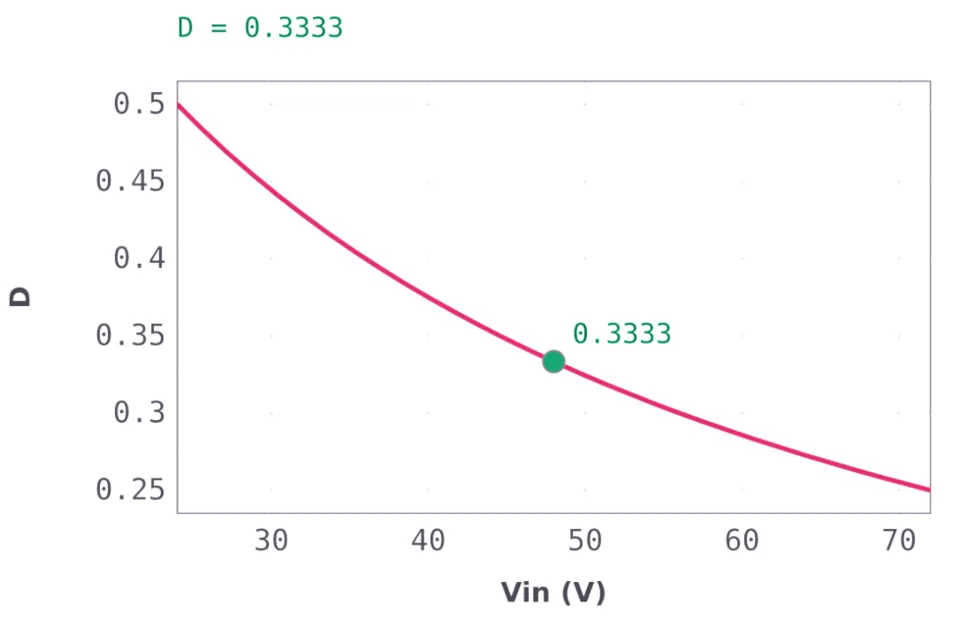 Flyback converter in continuous conduction |
Ask in words: 8 examples
Each question below was asked on this release; the comment under it is the line it printed.
import power_electronics_ai999x as power_electronics

a = power_electronics.ask(
    "Single-phase commutation overlap: Vs = 230 V, f = 0.05 kHz, Ls = "
    "2 mH, Id = 20 A, alpha = 30 deg"
)
print(a.outcome, a.values)
# SOLVED {'u_deg': 7.93041601856, 'Vdc': 171.330264284, 'dV': 8.0}

a = power_electronics.ask(
    "Boost converter output ripple: Vin = 12 V, Vout = 48 V, Io = 1 A, "
    "C = 47 uF, fs = 100 kHz"
)
print(a.outcome, a.values)
# SOLVED {'D': 0.75, 'dVo': 0.159574468085, 'dVo_pct': 0.332446808511}

a = power_electronics.ask(
    "Three-phase commutation overlap: VLL = 400 V, f = 0.05 kHz, Ls = "
    "0.5 mH, Id = 100 A, alpha = 30 deg"
)
print(a.outcome, a.values)
# SOLVED {'u_deg': 5.85622851056, 'Vdc': 452.81808074, 'dV': 15.0}

a = power_electronics.ask(
    "Inductor area product: L = 100 uH, Ipk = 12 A, Irms = 10 A, Bmax "
    "= 300 mT, J = 4 A/mm^2, Ku = 0.4"
)
print(a.outcome, a.values)
# SOLVED {'Ap': 2.5e-08, 'Ap_cm4': 2.5}

a = power_electronics.ask(
    "MOSFET conduction loss: Rds25 = 0.01 ohm, alpha = 0.007, Tj = 125 "
    "degC, Irms = 20 A"
)
print(a.outcome, a.values)
# SOLVED {'Rds_T': 0.017, 'P': 6.8, 'P_25': 4.0, 'ratio': 1.7}

a = power_electronics.ask(
    "Transformer turns: waveform = square, V = 48 V, f = 100 kHz, Bmax "
    "= 150 mT, Ac = 1.25 cm^2, Vs = 12 V"
)
print(a.outcome, a.values)
# SOLVED {'Np': 6.4, 'Ns': 1.6, 'n': 4.0, 'volts_per_turn': 7.5}

a = power_electronics.ask(
    "Critical inductance: topology = buck, Vin = 24 V, Vout = 12 V, fs "
    "= 100 kHz, R = 10 ohm"
)
print(a.outcome, a.values)
# SOLVED {'D': 0.5, 'L_crit': 2.5e-05, 'Io': 1.2}

a = power_electronics.ask(
    "DC-DC conversion ratio: topology = boost, Vin = 12 V, D = 0.6"
)
print(a.outcome, a.values)
# SOLVED {'M': 2.5, 'Vout': 30.0, 'polarity': 'same'}
Command line: 15 examples
Each command below was run with power-electronics of this release; the lines under it are the answer it printed (the full answer goes on with the method, every input in SI units and the conditions it assumes).
$ power-electronics solve pe_converter_small_signal topology=boost "Vin=12 V" D=0.5 "L=50 uH" "C=100 uF" "R=10 ohm"
Gvd0 = 48 V
f0 = 1125.395395 Hz
Q = 7.071067812
f_rhpz = 7957.747155 Hz
rhp_zero = present

$ power-electronics solve pe_boost_ccm "Vin=12 V" "Vout=48 V" "L=100 uH" "fs=100 kHz" "Io=1 A"
D = 0.75
IL = 4 A
dIL = 0.9 A
IL_max = 4.45 A
IL_min = 3.55 A
V_switch = 48 V

$ power-electronics solve pe_bootstrap_capacitor "Qg=60 nC" "Ileak=200 uA" "fs=100 kHz" Dmax=0.9 "dV=0.5 V"
Q_total = 6.18e-08 C
C_min = 1.236e-07 F
C_recommended = 1.236e-06 F

$ power-electronics solve pe_boost_pfc "Vac=230 V" "f_line=50 Hz" "Vo=400 V" "Po=500 W" eff=0.95 "L=500 uH" "fs=65 kHz" "C=330 uF"
I_in_pk = 3.236186642 A
D_peak = 0.1868272016
dI_peak = 1.869819057 A
dI_max = 3.076923077 A
IL_at_peak = 4.17109617 A
dVo_pp = 12.05719266 V

$ power-electronics solve pe_dead_time_error "Vdc=600 V" "td=2000 ns" "fs=10 kHz" "V1=250 V"
dV_avg = 12 V
dV1_peak = 15.27887454 V
dV1_pct = 6.111549815

$ power-electronics solve pe_flyback_ccm "Vin=48 V" "Vout=12 V" n=2 "Lm=200 uH" "fs=100 kHz" "Io=2 A"
D = 0.3333333333
Im = 1.5 A
dIm = 0.8 A
Ipk_primary = 1.9 A
Ipk_secondary = 3.8 A
V_switch = 72 V

$ power-electronics solve pe_boost_nonideal_gain "Vin=12 V" D=0.75 "R=50 ohm" "RL=0.5 ohm"
M = 3.448275862
Vout = 41.37931034 V
efficiency = 0.8620689655
IL = 3.310344828 A
D_peak = 0.9
M_max = 5

$ power-electronics solve pe_steinmetz_core_loss k=3.2 alpha=1.4 beta=2.5 "f=100 kHz" "Bpk=100 mT" "Vc=5 cm^3"
Pv = 101192.8851 W/m^3
Pv_mW_cm3 = 101.1928851
P = 0.5059644256 W

$ power-electronics solve pe_dc_motor_armature_ripple "Vs=220 V" D=0.5 "fs=1 kHz" "Ra=1 ohm" "La=10 mH" "Ea=100 V"
I_max = 12.74942723 A
I_min = 7.250572773 A
dI = 5.498854453 A
I_avg = 10 A

$ power-electronics solve pe_pulse_waveform_rms A=12 D=0.25
avg = 3
rms = 6
ac_rms = 5.196152423
form_factor = 2
ripple_factor = 1.732050808

$ power-electronics solve pe_capacitor_filter_exact circuit=half-wave "Vp=169.7 V" "f=0.06 kHz" "R=500 ohm" "C=100 uF"
theta_off_deg = 93.03678865
alpha_deg = 48.23082389
dV = 43.13189012 V
V_avg = 148.1028626 V
I_D_peak = 4.514737529 A
conduction_deg = 44.80596476

$ power-electronics solve pe_dual_active_bridge_power "V1=400 V" "V2=48 V" n=8 "L=50 uH" "fs=100 kHz" "phi=30 deg"
P = 2133.333333 W
P_max = 3840 W
i0 = -7.2 A
i_phi = 5.866666667 A
I_rms = 6.175699091 A

$ power-electronics solve pe_foster_periodic_pulses "R=[0.05, 0.1, 0.15]" "tau=[0.0001, 0.003, 0.05]" "P=500 W" "tp=2 ms" "T=10 ms"
dT_peak = 66.45250612 K
dT_min = 15.57762553 K
dT_avg = 30 K
ripple = 50.87488059 K

$ power-electronics solve pe_peak_current_mode_slope "Vin=12 V" "Vout=8 V" "L=10 uH" "fs=300 kHz" "ma=0.3 A/us"
D = 0.6666666667
m1 = 400000 A/s
m2 = 800000 A/s
alpha = -0.7142857143
stable = stable
ma_min = 200000 A/s

$ power-electronics solve pe_boost_dcm "Vin=12 V" "L=10 uH" "fs=100 kHz" "R=100 ohm" D=0.4
K = 0.02
M = 3.372281323
Vout = 40.46737588 V
D2 = 0.1686140662
I_pk = 4.8 A
Io = 0.4046737588 A
Guides
- Desktop app guide: the window, every calculation, scenes and charts: PDF · HTML · Markdown
- Python guide: every calculation with a Python example: PDF · HTML · Markdown
- Command-line guide: every calculation with the command and what it printed: PDF · HTML · Markdown
Every calculation, with its formula, a worked example and its figures: Power Electronics on ai999x.com. Install guides for the app and the command line: https://www.ai999x.com/desktop-cli/.
Version 1.6.7 · License: Apache-2.0 · Author: Ibnul Jaif Farabi · Organization: AI999X · Contact: support@ai999x.com · Support the project
The Future Is Self-Improving.
- Downloads last month
- 297
Evaluation results
- identical on every platform on Golden answers (482 documented questions, Windows + Linux Python 3.10-3.14)self-reported1.000