| --- |
| language: en |
| license: mit |
| tags: |
| - vision |
| inference: false |
| model_name: microsoft/git-base-vatex |
| --- |
| |
| # GIT (GenerativeImage2Text), base-sized, fine-tuned on VATEX |
|
|
| GIT (short for GenerativeImage2Text) model, base-sized version, fine-tuned on VATEX. It was introduced in the paper [GIT: A Generative Image-to-text Transformer for Vision and Language](https://arxiv.org/abs/2205.14100) by Wang et al. and first released in [this repository](https://github.com/microsoft/GenerativeImage2Text). |
|
|
| Disclaimer: The team releasing GIT did not write a model card for this model so this model card has been written by the Hugging Face team. |
|
|
| ## Model description |
|
|
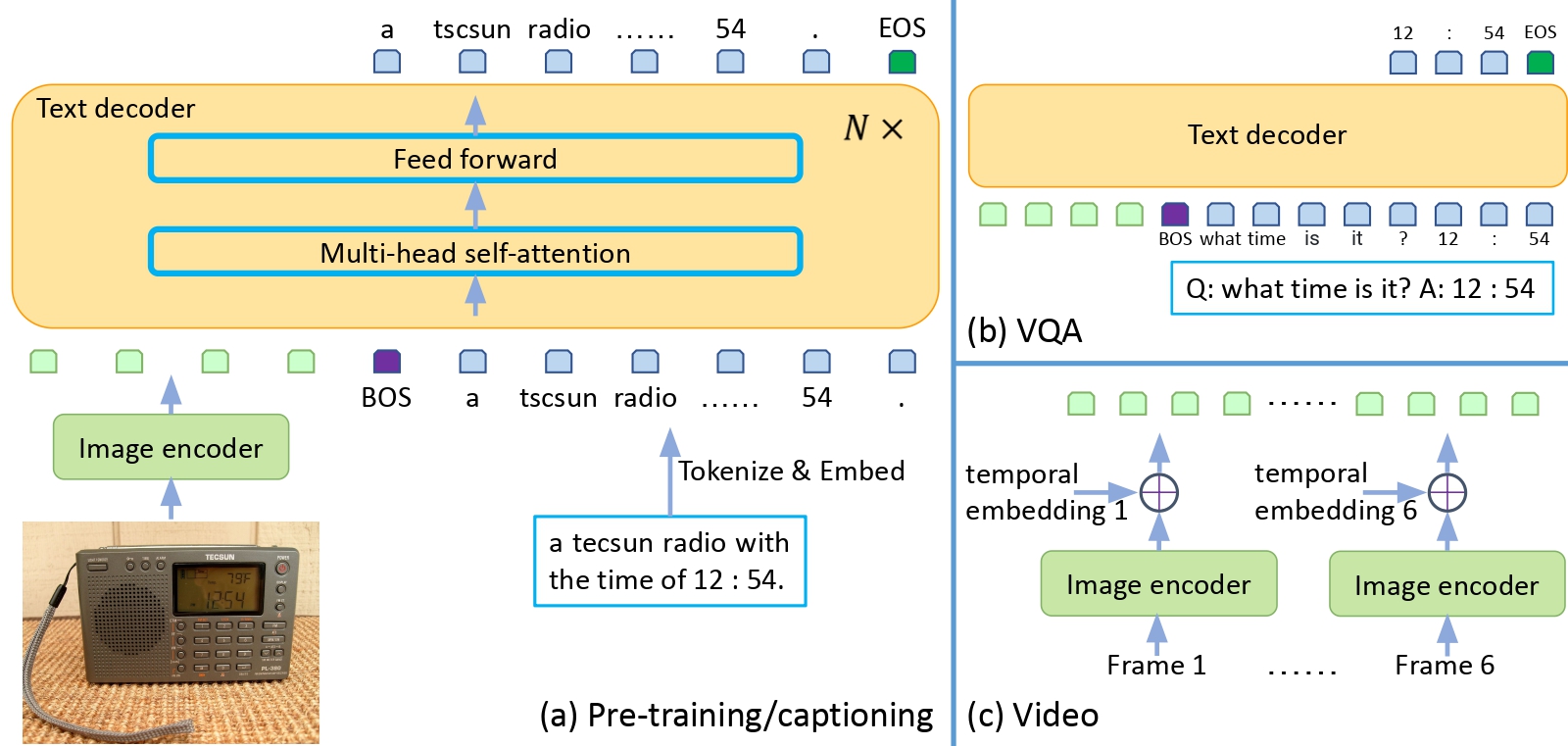
| GIT is a Transformer decoder conditioned on both CLIP image tokens and text tokens. The model is trained using "teacher forcing" on a lot of (image, text) pairs. |
|
|
| The goal for the model is simply to predict the next text token, giving the image tokens and previous text tokens. |
|
|
| The model has full access to (i.e. a bidirectional attention mask is used for) the image patch tokens, but only has access to the previous text tokens (i.e. a causal attention mask is used for the text tokens) when predicting the next text token. |
|
|
|  |
|
|
| This allows the model to be used for tasks like: |
|
|
| - image and video captioning |
| - visual question answering (VQA) on images and videos |
| - even image classification (by simply conditioning the model on the image and asking it to generate a class for it in text). |
|
|
| ## Intended uses & limitations |
|
|
| You can use the raw model for video captioning. See the [model hub](https://huggingface.co/models?search=microsoft/git) to look for |
| fine-tuned versions on a task that interests you. |
|
|
| ### How to use |
|
|
| For code examples, we refer to the [documentation](https://huggingface.co/transformers/main/model_doc/git.html). |
|
|
| ## Training data |
|
|
| From the paper: |
|
|
| > We collect 0.8B image-text pairs for pre-training, which include COCO (Lin et al., 2014), Conceptual Captions |
| (CC3M) (Sharma et al., 2018), SBU (Ordonez et al., 2011), Visual Genome (VG) (Krishna et al., 2016), |
| Conceptual Captions (CC12M) (Changpinyo et al., 2021), ALT200M (Hu et al., 2021a), and an extra 0.6B |
| data following a similar collection procedure in Hu et al. (2021a). |
|
|
| => however this is for the model referred to as "GIT" in the paper, which is not open-sourced. |
|
|
| This checkpoint is "GIT-base", which is a smaller variant of GIT trained on 10 million image-text pairs. |
|
|
| Next, the model was fine-tuned on VATEX. |
|
|
| See table 11 in the [paper](https://arxiv.org/abs/2205.14100) for more details. |
|
|
| ### Preprocessing |
|
|
| We refer to the original repo regarding details for preprocessing during training. |
|
|
| During validation, one resizes the shorter edge of each image, after which center cropping is performed to a fixed-size resolution. Next, frames are normalized across the RGB channels with the ImageNet mean and standard deviation. |
|
|
| ## Evaluation results |
|
|
| For evaluation results, we refer readers to the [paper](https://arxiv.org/abs/2205.14100). |


